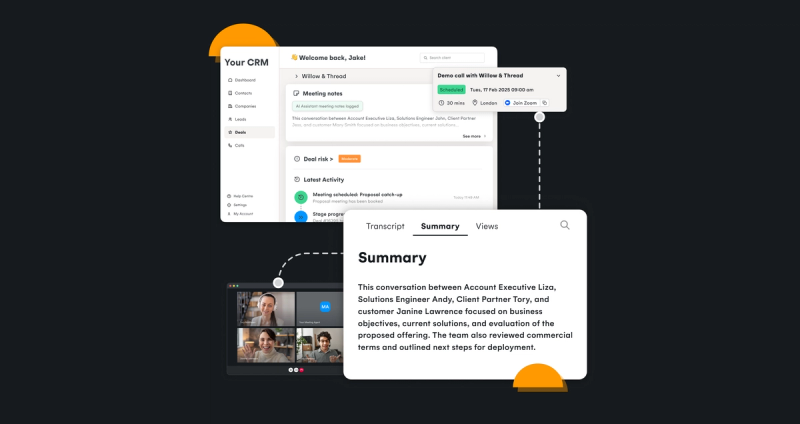
Cronofy is the temporal infrastructure connecting agents, systems, and teams. Agents act, systems record, teams decide, and time is the constraint none of them can escape. Cronofy is the orchestration layer that keeps all three in step.
For product builders, that means one grid to coordinate availability, run the full scheduling lifecycle, and capture meeting intelligence, all inside your own product. You start with the problem you need to solve today and add capabilities as your product grows, without rebuilding the foundation each time.
Here is how the temporal grid and the capabilities that run on it fit together.
The temporal grid
The grid is the foundation. It unifies the three things every meeting workflow depends on: availability control, the full scheduling lifecycle, and meeting intelligence. Every Cronofy capability runs on this same grid, so they stay connected as you add them.
A calendar sync you ship this quarter and an AI agent you add next year draw on the same availability, the same scheduling logic, and the same meeting data. You build once and extend, rather than stitching separate integrations together.
Calendar API
The Calendar API is the base layer the grid is built on. It connects your product to Google, Microsoft, and Apple calendars, including on-premise Exchange, through a single integration with a 99.99% service guarantee.
Building those connections yourself is slow and costly, and they need constant upkeep as providers change. Cronofy handles authorization and syncing as the intermediary, so you work with one API instead of many. You can take full calendar sync or free/busy-only access, and real-time push notifications keep your product in step as calendars change.
Availability control
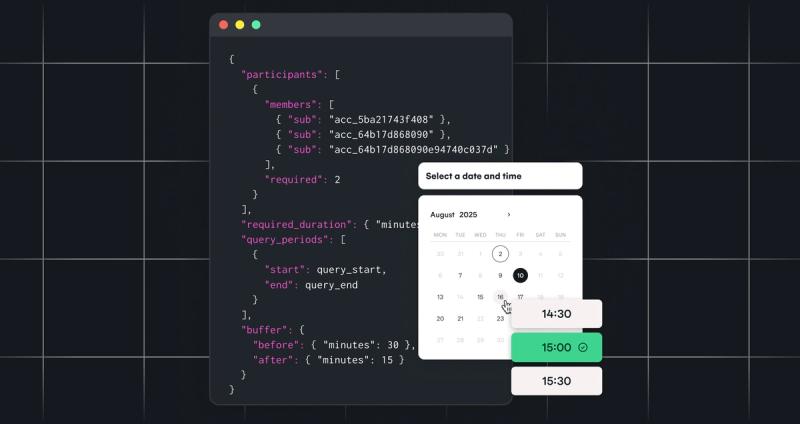
Availability control builds on real-time sync. Each request checks live availability across the calendars, agents, and systems involved, so your product only ever offers times that genuinely work. That prevents double-bookings and removes the back-and-forth of confirming who is free.
You can add buffers to reserve time before or after an event. A recruiter who needs half an hour to prepare for an interview, for example, gets that protected automatically. Buffers never show as events themselves, but everything else schedules around them.
Embedded Scheduler
The Embedded Scheduler is the fastest way to add scheduling to your product. It is a pre-built, fully managed experience that drops in through the Cronofy Embed package, so your team launches without building custom UI.
It supports multi-person scheduling, multi-event coordination, rescheduling, and complex selection rules. Client and server-side callbacks track bookings and reschedules so your product stays informed. You can brand the experience to match your design, and it integrates with major ATS platforms including Paycor, Workday, SAP SuccessFactors, SmartRecruiters, Greenhouse, and BambooHR.
For something like a multi-part interview - a meeting with HR, then the team lead, then the wider team - the scheduler works out an order that fits everyone's real availability. Whether you are booking one interview or 100, it takes the same effort.
White Label API
When you need full control, the White Label API gives you Cronofy's modular endpoints to build custom scheduling and meeting workflows directly inside your product, with no pre-built UI in the way.
It suits complex workflows: multi-user coordination, edge cases, and your own business logic. The result is a fully white-labeled, native experience that keeps users inside your product.
Meeting Agents
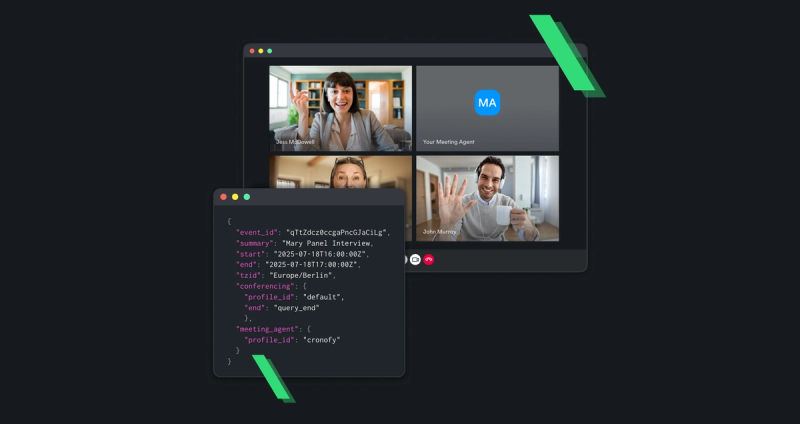
Meeting Agents bring meeting intelligence to the grid. A single API records, transcribes, and summarizes meetings across Zoom, Google Meet, and Microsoft Teams, in more than 30 languages.
The meeting data runs entirely on Cronofy's infrastructure with no third-party subprocessors. It is processed and stored only in the region you choose, with data centers in the UK, US, Canada, Germany, Australia, and Singapore.
The agent name and avatar are fully configurable to match your product. A Meeting Agent can run standalone from a join URL, or attach directly to an event scheduled through Cronofy and stay aligned if the meeting moves.
Scheduling Agent
The Scheduling Agent brings scheduling to where teams already work. It combines real-time availability with AI to understand a request and propose times that fit, inside the tools they already use, like Microsoft Teams and Slack, and AI assistants like Copilot and Claude.
It handles single, multi-person, and panel meetings across timezones, and invitees can self-schedule through personalized links based on live availability. The result is fewer threads hunting for a time that works for everyone.
MCP Server
The MCP Server opens the grid to AI agents directly. Through it, an agent can reach scheduling, availability, and meeting context on its own, without waiting on a person to fill the gaps.
This is what lets agents act on the same temporal grid your product already runs on, so the workflows you automate stay connected to the systems and teams around them.
Data security and location
Security is built into the infrastructure. Cronofy is ISO 27001, ISO 27018, and ISO 27701 certified, SOC 2 Type 2 attested, and GDPR, CCPA, and HIPAA compliant.
Cronofy operates as a single data processor, which keeps vendor management simple for enterprise customers. You choose the region your data is processed and stored in, and calendar and meeting data stays controlled and is never used outside the scope of your customer relationship. That matters most in regulated fields like healthcare, financial services, and enterprise HR.
Building on the grid
Because every capability runs on the same grid, you do not have to commit to your whole roadmap up front. Start with calendar sync, add scheduling, capture meeting intelligence, or enable AI agents, in whatever order your product needs. Each capability works on its own or alongside the rest.
Whatever you are coordinating, time sits at the center of it. Cronofy gives you the infrastructure to handle it reliably, at scale, inside your own product.
Get in touch to talk through what your product needs, or get your sandbox.