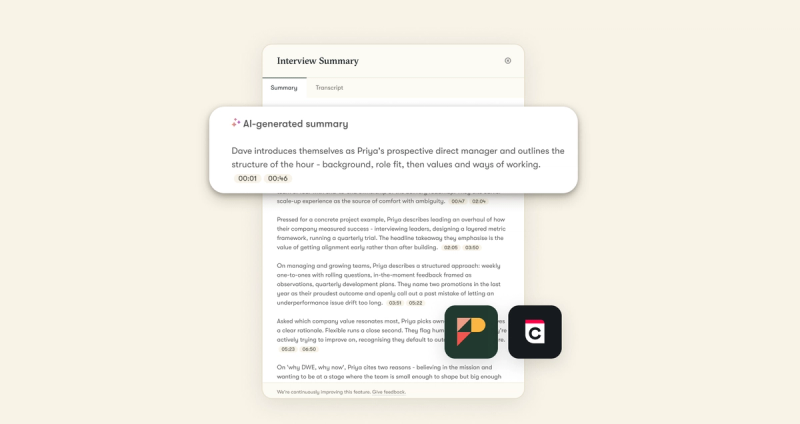
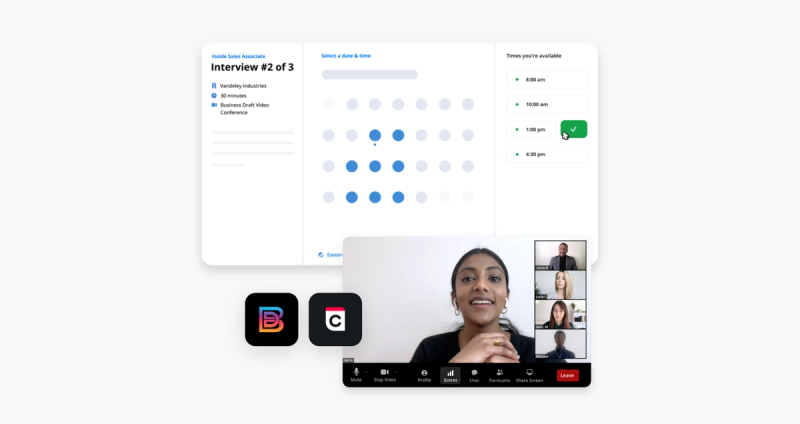
Calendar scheduling and meeting recording are core capabilities in modern ATS (Applicant Tracking System) and HCM (Human Capital Management) platforms. They automate interview scheduling, capture interview conversations, generate summaries, and turn meetings into structured hiring data.
An HR platform may need access to calendars to schedule interviews, coordinate hiring panels, or automate workflows. Meeting recording and transcription can add even more value: recordings, transcripts, summaries, interview notes, and structured candidate insights.
But those capabilities also turn a familiar SaaS product into a system handling highly sensitive workplace data. These capabilities can be powerful differentiators, but only if enterprise customers can deploy them safely and securely. That means achieving new levels of security and compliance.
What does a security review look for?
For ATS and HCM product managers and engineers, enterprise deals rarely stall because buyers don't like the software. It's often because their security teams aren't comfortable with what data the product can access, what it records, where that data goes, and how long it will be retained.
When enterprise customers undertake a security review, there are few, if any, shortcuts software vendors can take. The fastest route through a security review is not persuading the buyer that their concerns are unnecessary or unwarranted. Instead, vendors need to ensure those concerns are easy to address.
Ultimately, enterprise security teams need to see evidence that your product treats sensitive HR data as something to govern, and not just something to be processed. Your software has to meet the highest security and compliance standards, which means building clear data and consent workflows, minimizing permissions, controlling access, and giving customers auditable controls.
Security is now a product requirement
With this in mind, for product and engineering leaders there's a simple lesson to be learned: a security review isn't just a procurement-stage exercise. It needs to be addressed in the product architecture.
Speeding a product through an enterprise security review generally involves being able to answer three questions directly:
- What can you access?
- What happens to the data?
- What control does the customer have over it?
Build those answers into the design of the product architecture, and into the evidence you give to buyers, and you can turn a late-stage deal blocker into a repeatable enterprise sales process.
What are the key security considerations?
When looking at enterprise customers' security concerns, there are some key considerations that product managers and engineers need to be aware of in the design and scope of their products. Cronofy can help address some of these considerations, including:
- Flexibility in how they connect their calendars – not all enterprises can accept full calendar sync. With Cronofy's free/busy-only access, a platform doesn't have to read the whole calendar to schedule against it. Cronofy supports full read/write calendar sync or free/busy-only access, so the integration takes the least access the product actually needs.
- Enterprise Connect for bulk authorization – an IT admin can authorize on behalf of the whole organization in one go, rather than chasing every end user for individual consent. Adoption stops depending on a user-by-user opt-in.
- Keeping customers' data within their geographies – Cronofy runs six regional data centers: UK, US, Canada, Germany, Australia and Singapore. Customer data stays in the data center the customer chooses. The one exception is meeting transcription, which may be processed in another region of the same cloud provider, for example the EU region for the UK data center. Recordings and transcripts are still stored in the chosen data center. The detail is in our privacy notice.
- Having multiple sub-processors that buyers need to review – most platforms add one vendor for the calendar and another for capture, then have to defend both in security reviews. Cronofy provides one sub-processor for scheduling and meeting capture, running on the same underlying infrastructure, with no third-party sub-processors behind recording or transcription.
- Meeting the highest security and compliance standards – Cronofy is ISO 27001, ISO 27018 and ISO 27701 certified, SOC 2 Type II attested, and GDPR, CCPA and HIPAA compliant. Cronofy is also Microsoft certified across all Microsoft connectivity options and the Teams agent, and offers a 99.99% uptime SLA.
Prepare to drive enterprise sales faster
What is the most effective way to shorten enterprise sales cycles? Creating a reusable technical package before the first security questionnaire floods in will speed the flow. This may include, but need not be restricted to, the following:
- An architecture diagram that shows calendar, meeting, AI, storage, and customer-system boundaries
- A sub-processor list that includes the function each provider performs
- A data-flow diagram that shows where recordings, transcripts, tokens, and metadata travel
- A permission matrix that maps every OAuth/API permission to its product purpose
- A security controls overview covering encryption, IAM, tenant isolation, logging, monitoring, and incident response
- An AI processing overview that explains model providers, training, retention, and geographic processing
- A customer-admin control matrix that shows which security and privacy controls customers can configure
Overall, the purpose is not to produce more paperwork, but to make the architecture easier to understand for everyone involved in approving the deal.
Security and compliance built in
At Cronofy, we are trusted with the calendar data of millions of people. That requires that we place privacy and security at the heart of all of our design decisions, technology choices and processes.
We designed our temporal infrastructure to treat events that people put in their calendars separately from events that applications create via our APIs. This allows applications to request just free/busy access to their users' calendar data, yet still create events when bookings are made.
It wasn't just a case of making this technically possible. We also had to build the security infrastructure around the data to protect it. We fully recognize and understand the challenges HR Tech product managers and engineers face in meeting security and compliance review standards.
Customers of the software vendors that use Cronofy can be confident that we take their security seriously, and employ best practices to ensure privacy is never compromised.
For more information
Certificates, audit reports and more are available through our compliance center.