Scheduling and meeting workflows are a human subject. They're about people and their time. Making scheduling agent-ready means an agent can find the meeting, book it and move it under the same rules your UI follows, while the people involved get the same experience. Every change lands back on your platform's record, along with what was said.
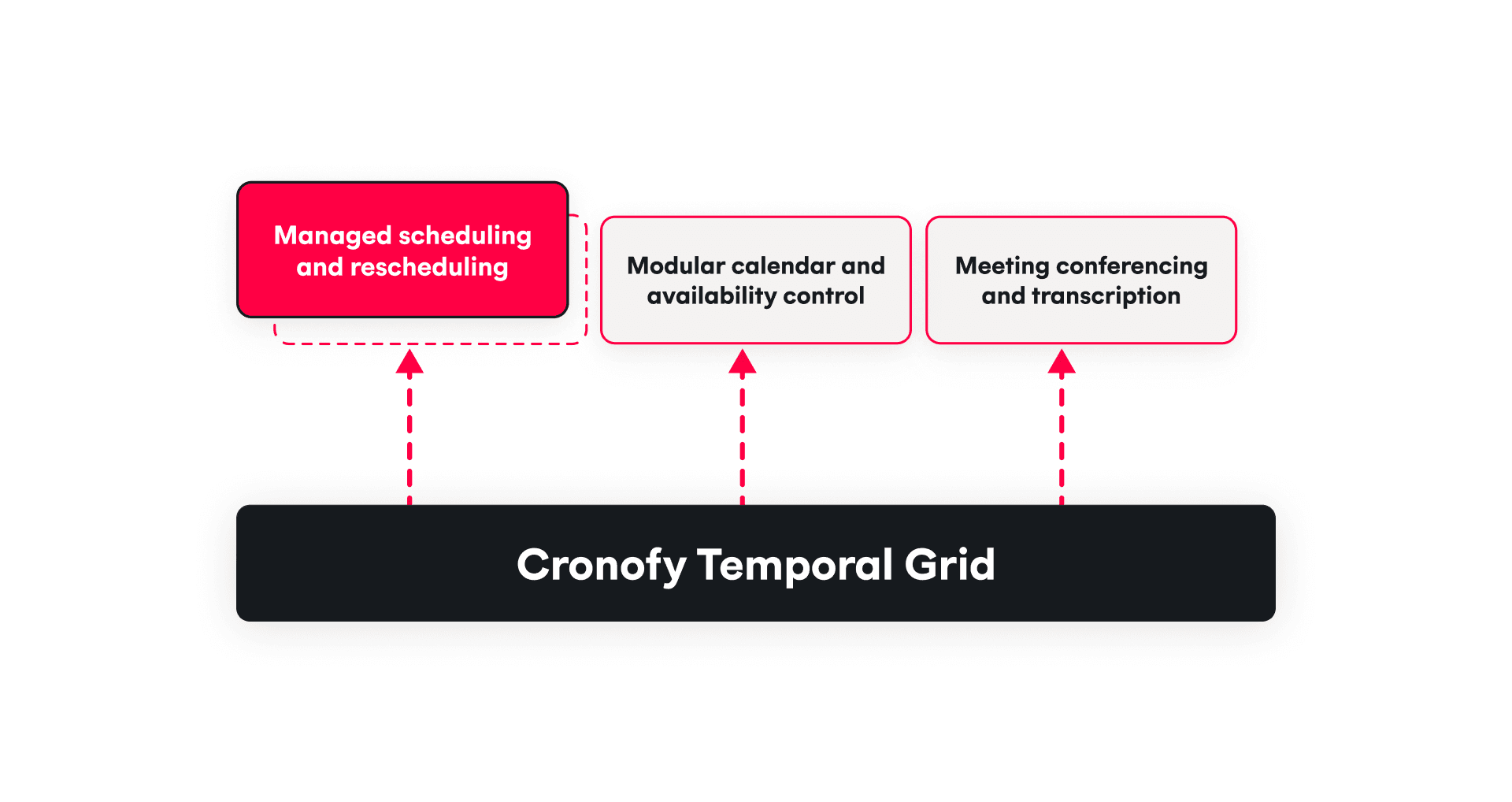
That's what managed scheduling and rescheduling brings to our offering for integrators. It completes a set of three capability groups, joining modular calendar and availability control, and meeting conferencing and transcription. All three run on one infrastructure, under one OEM license.
Three capability groups, one infrastructure
Modular calendar and availability control has been the foundation of Cronofy from the start. Meeting conferencing and transcription brings people together and captures what was said. Together they're the Temporal Infrastructure that lets your product see, schedule and transcribe every conversation.
What we left to you was the workflow between them. You had to model the scheduling controls you needed, work out how rescheduling should behave, and decide what rules applied around it. All of the pieces were there. You had to do the legwork to glue them together. In effect, every integrator was building their own scheduling request model.
For years now we've been developing and refining our own scheduling request model. It has been running the Scheduler, our product for teams to use directly, proven with customers scheduling at scale and inside BambooHR and Paycor. Now we're sharing it. Managed scheduling and rescheduling is those pieces glued together the way we always intended them to be.
Agents, systems and teams all work through that same scheduling request model, from your UI, the API, or our MCP Server, with the same rules applied in each. That gives your AI the full record of what happened, and with Meeting Transcripts, what was said. For an ATS, that's every interview behind a hiring decision. For an HCM suite, it's every one-to-one and review.
What scale taught us
Managed scheduling is built from the edge cases we've already worked through, and most of them are human. People are busy, interviewing is a side job, and plans change. We've seen it all firsthand with customers such as Wise, coordinating panel interviews across a large, fast-growing hiring team.
Panels. We started out with panels of four or five people. Now we see requests to find one or two interviewers out of a pool of 80 or more, and they still need a good answer, quickly.
Constraints. Those big pools exist for a reason. Interviewing isn't an engineer's main job. It's something they do on the side, so you want to take as little of their time as possible and spread the load evenly across the group: one interview a day, two a week. All of that was already possible through the availability layer. Now you declare what you want to happen, or what your customers want to happen, and we take care of it.
Rescheduling. We handle the workflow from the intent to have a meeting, through it being scheduled, through it being rescheduled. Someone on the panel calls in sick and needs replacing. Someone can no longer make the time, so the same intent moves to a new one. Alongside all of that, the meeting can be transcribed through the same layer with Meeting Transcripts, whether it's an interview, a one-to-one or a performance review.
From what we've seen, managed scheduling covers almost every scheduling workflow. If yours is the exception, we want to hear about it so we can close the gap. In the meantime, the control is still there.
Your UI, our UI, or a mix of both
These capabilities come in different flavors: headless, embedded, and hosted. Not everything comes in every flavor. Some things will only ever be hosted. Some start out hosted and move toward headless.
Control works the same way, and it's as optional as we can make it. The Embed gives you the least control and does the most for you. Headless sits in between, leaning on our scheduling request model while the UI stays yours. If you want to own every detail, you can go all the way down to modular calendar and availability control. That's not going away.
The aim is for you to do as little work as possible to get started, then expand and refine how your product uses Cronofy without rewriting it from scratch.
Built backwards
We built managed scheduling and rescheduling backwards. Cronofy started with systems in 2014, an API other products built on, and only later built the Scheduler for teams to use directly. Managed scheduling went the other way. Teams first, then agents, then systems.
Agents were the bridge. Exploring MCP and building our own Scheduling Agent led us toward headless operations, so an agent could drive the same workflow a person could. Once that worked, systems could too.
As a plugin, the Scheduler could only work with the API it was given. Built into the product, as BambooHR and Paycor have done, we and the integrator can realize the full vision for the workflow as a whole, every conversation across the employee lifecycle, from the vacancy opening through interviews and onboarding to one-to-ones, reviews and offboarding. That's the kit we're now opening up to every platform on our OEM license.
What this means for you
If you're replatforming scheduling or making it agent-ready, this is our gold standard. It's what we think you should be building on today.
If you've built on our API in the past, you'll soon be able to upgrade to the new model. Only if you want to, but we believe it's worth your time.
And for everyone, we're not dropping support for anything. We're committed to maintaining everything that already exists, and there's no reason not to, because it all sits on the same infrastructure. Until now, getting the Scheduler's capabilities inside another product meant that product's customers buying from us directly. Now it's one OEM license, one infrastructure, one set of capabilities.
We've spent a decade building this platform. It's the Temporal Infrastructure we'll build the next decade on.
Making your platform's scheduling agent-ready? Come with us. Get in touch and speak to an expert about where to start.
Already a customer? Talk to your customer success manager or our support team about what this means for your integration.
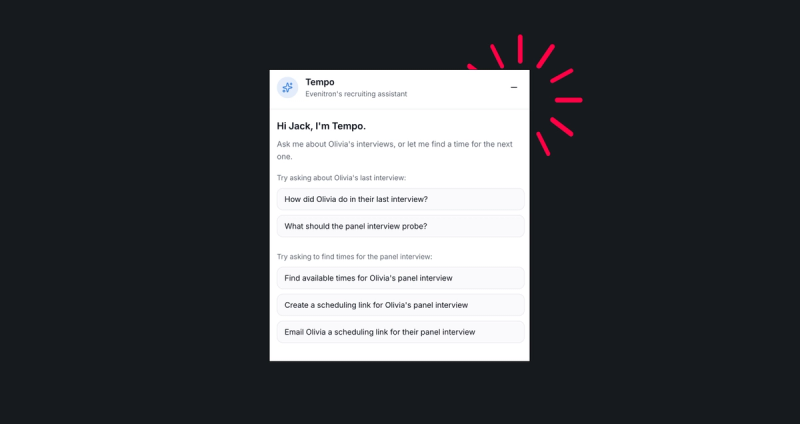
How to build an AI agent into your HR platform that reviews and schedules interviews
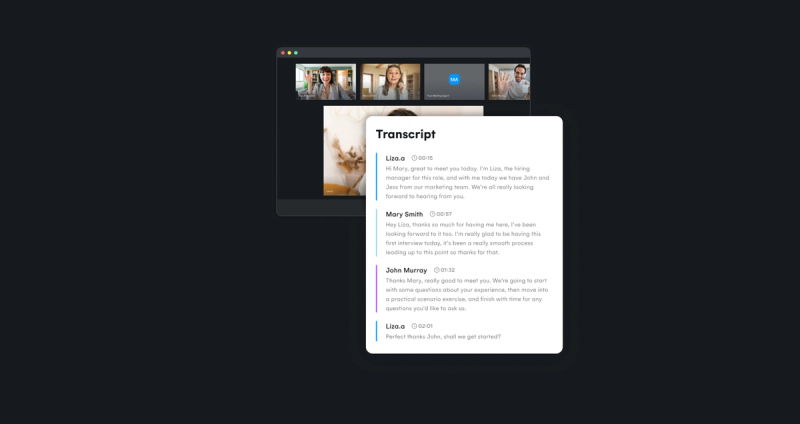
How to record and transcribe HR conversations inside your platform