What context do HR Tech AI features need?
The context layer is the captured record of what was said in a conversation, tied to the right candidate or employee record, so a platform's AI can reason over it. Today's ATS product teams are increasingly shipping AI features around interview and employee data, such as scoring candidates, generating interview feedback and summarizing assessments. HCM suites are producing appraisal insights, tracking sentiment and helping managers to better understand employee performance.
Yet the conversation itself, where the decisions get made, is the richest record of these interactions. Interviewers already expect a notetaker in the room, and if the product doesn't offer one they bring their own, which is why the data exists but sits somewhere else. And if no one brings a tool, there's no record at all.
Customers comparing AI features across competing platforms will notice the difference between an answer grounded in an actual conversation and one built on whatever someone remembered to enter afterwards. HR Tech platforms may be competing on the intelligence layer, but the context layer beneath it decides the outcome.
What does a usable record of a conversation look like?
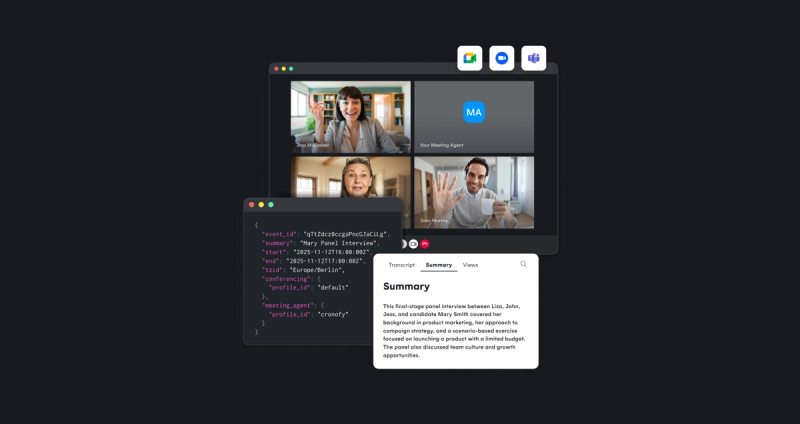
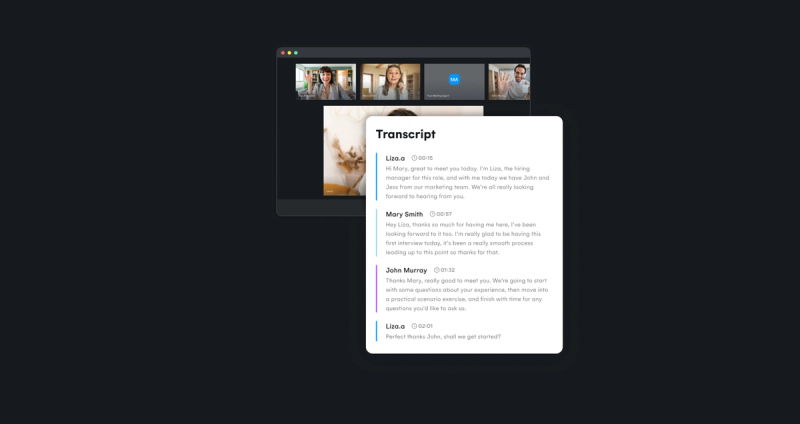
A captured conversation also needs to be usable by the platform and the AI features built on top of it. That means it needs to be structured so a feature can reason over it, with timestamps, linked to the relevant meeting and business record, along with a summary derived from the original conversation.
The summary alone is a representation of the source. If the AI needs to revisit a particular answer, distinguish between speakers or understand how a conclusion was reached, the underlying transcript needs to be there as evidence.
Manual logging cannot reliably provide that foundation. Notes can vary between interviewers and managers, omit details, or reflect individual interpretations, and are often never written at all. A third-party notetaker is worse for the platform than no notetaker at all. Because the conversation was captured, the customer thinks the problem is solved and never asks the platform to fix it, while the platform's own AI still can't see any of it.
What HR Tech product teams need is a reliable conversation record that can be retrieved, attributed and used as structured context across the product.
Which hiring AI features depend on the interview transcript?
Hiring platforms have an obvious advantage when solving this problem. They often create the interview meeting themselves, which makes it easier to attach capture to a scheduled event and connect the resulting transcript to the candidate and interview stage. But the value extends well beyond meeting notes.
Score candidates on what they actually said
Structured application data, assessment results and stage progression tell a hiring platform a great deal about a candidate's journey. But they don't necessarily reveal, for example, how the candidate answered a competency question.
The signal might be in the example they chose, the reasoning behind their decision, or how they explained a difficult trade-off. A transcript gives an AI feature evidence from the interview itself, rather than asking it to infer performance from the metadata.
The gap appears when an interviewer uses their own notetaker. That evidence never reaches the hiring platform, leaving its candidate-scoring feature with an incomplete picture.
Generate interview feedback and scorecards
AI-generated feedback can reduce administrative work and help interviewers produce more consistent evaluations. But the output needs to be grounded in the right interview, linked to the correct candidate, and available at the appropriate point in the hiring workflow.
A summary sitting in a separate document is not an integrated feature. Someone still has to find it, copy it and connect it to the decision. When the transcript is attached to the interview record, feedback can be generated in context, reviewed against the source and carried into the existing scorecard workflow.
Support better debriefs
Hiring decisions often involve several interviewers reaching different conclusions. One sees strong communication skills, while another remains unconvinced by the candidate's problem-solving approach.
The more useful AI feature lets the team examine what each interviewer heard, find the relevant answers and understand where their interpretations differed.
The gap is the lack of a searchable transcript. Without one, the debrief relies on recollection and written impressions. With the transcript, the platform can help the team compare evidence rather than rely on opinions alone.
Why do HR suites lose more of the conversation record?
In hiring, the platform usually creates the meeting, so capture can be attached when it is booked. In an HR suite, one-to-ones and appraisals are often arranged outside the platform, so capture has to attach to meetings it didn't create, and suites tend to lose more of the record than ATS platforms do.
That is a more complex integration problem, but also a significant product opportunity. Book the meetings your platform creates, and see the ones it doesn't.
Write appraisal summaries from the review itself
An appraisal is an important record in an employee's lifecycle. The gap is that what reaches the platform is often what a manager remembers to type afterwards, which can be both incomplete and the single most consequential record in the system. The written review may be accurate, but it is inevitably shaped by what the manager recalls or chooses to include.
A transcript gives appraisal insights a much stronger foundation. The AI can help structure the discussion, identify recurring themes and distinguish agreed outcomes from observations, with the source available for review.
Carry one-to-ones forward
A one-to-one feature that can't recall what was agreed previously is essentially a notes field with extra steps. Meaningful continuity requires the platform to understand previous commitments, outstanding questions and development goals.
The gap is that one-to-ones frequently happen in a chat tool or an informal call, leaving the HR system with no record of the discussion. Connecting the conversation to the employee record allows AI to support continuity between meetings, helping managers revisit commitments rather than reconstructing them from memory.
Document absence, leave and wellbeing conversations
These conversations require particular care. Accurate records matter to employers and employees alike, especially when decisions, support arrangements or follow-up actions need to be understood later.
The gap is that the conversation and the formal approval often sit in different systems. The HR suite records the leave decision, but misses the context around it. A properly connected record can help preserve agreed actions and relevant context, subject to appropriate access controls, consent and retention policies. The aim is to ensure important conversations are documented accurately.
It's tempting to solve capture on a per-module basis. Hiring gets it first because that's where the need is often greatest, followed by onboarding, then performance, each with its own build and its own maintenance. A suite selling AI needs the record to be complete across the whole lifecycle, which makes it a single infrastructure decision across the suite.
How do HR Tech platforms close the gap?
Cronofy is the Temporal Infrastructure connecting agents, systems and teams, and it lets HR Tech platforms see, schedule and transcribe their HR conversations, including meetings the platform did not create. Meeting Transcripts captures the conversation, and Cronofy's modular calendar and availability control capabilities connect it to the calendar event and the platform's own record.
One important distinction is that capture connects to the calendar event. When the meeting moves, the transcript remains associated with the relevant event and, through the integration, the appropriate business record. That creates a foundation for AI features to work in the context of the actual meeting.
The raw transcript sits alongside the summary, giving the platform's own AI the source material it needs. Cronofy provides the transcription capability, while the HR Tech platform keeps ownership of its intelligence layer and the product experience built around it.
In HR, reluctance to be recorded may come from the interviewer or manager as much as the candidate or employee. Cronofy offers a transcript-first, video-optional approach.
For HR Tech, security and compliance matter as much as functionality. Cronofy's safeguards include no third-party subprocessors behind recording or transcription, recordings deleted after seven days, and transcripts never used to train AI models. These are important considerations for product and security teams evaluating conversation infrastructure, alongside the applicable consent, access and retention requirements for their own deployments.
Keeping everything in context
As AI becomes central to HR Tech products, the ones that stand out will ground their AI in the right context. A shared context layer connects the conversations behind interviews, appraisals and employee interactions to the right records and workflows, so HR Tech platforms can deliver more meaningful AI capabilities while keeping the privacy, security and control these sensitive conversations demand.
Customer spotlight: how Pinpoint built AI scorecards on interview transcripts
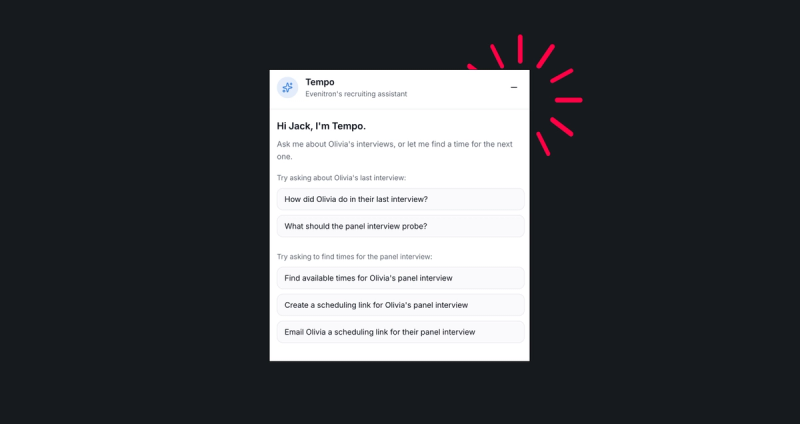
Cronofy's HR Tech customer Pinpoint added AI notetaking on an existing Cronofy integration, and built AI-powered scorecards that surface timestamped transcript sections against each scorecard question. Pinpoint's agentic layer means the product is no longer bound by its own UI. Users can tap into Pinpoint's features and data from wherever they work, with agents acting on their behalf. Interview data sits at the core of that.
By powering meetings end-to-end, Cronofy connects the foundational context layer that Pinpoint's agentic strategy depends on. In a crowded ATS market, Pinpoint found exactly where their edge is, and they're now doubling down on it.