

Build features, not infrastructure
Building scheduling features into your HR product might seem relatively straightforward. That’s until you consider edge cases such as more calendar providers, more rules, rescheduling, conferencing links and meeting capture. Doing this in-house means your team has to spend more time building and maintaining infrastructure, instead of adding the features that set your product apart.
Buying the infrastructure is the alternative. In this report, we set out the challenges of in-house builds, and how focusing on building scheduling features, rather than infrastructure, is not only time- and cost-efficient for HR tech dev teams, but also ensures users don’t switch to vendors with deeper AI capabilities.
6–9 months to launch, then 42% of engineering time to maintain
Development costs over 6–9 months can be significant. Post-launch, teams that build their own infrastructure layer then need to spend 42% of their ongoing engineering time maintaining it.
Every hour of dev team time that goes into scheduling infrastructure impacts on the development roadmap for vital features, including AI capabilities, that differentiate your product.
A sequence that starts simple and gets more complex
- Add scheduling. First impressions are it is a relatively simple feature build.
- More complexity. More systems, more rules, more edge cases arrive.
- More attention. Maintenance becomes an ongoing requirement.
From one seemingly simple build, the dev team ends up managing six areas of complexity:
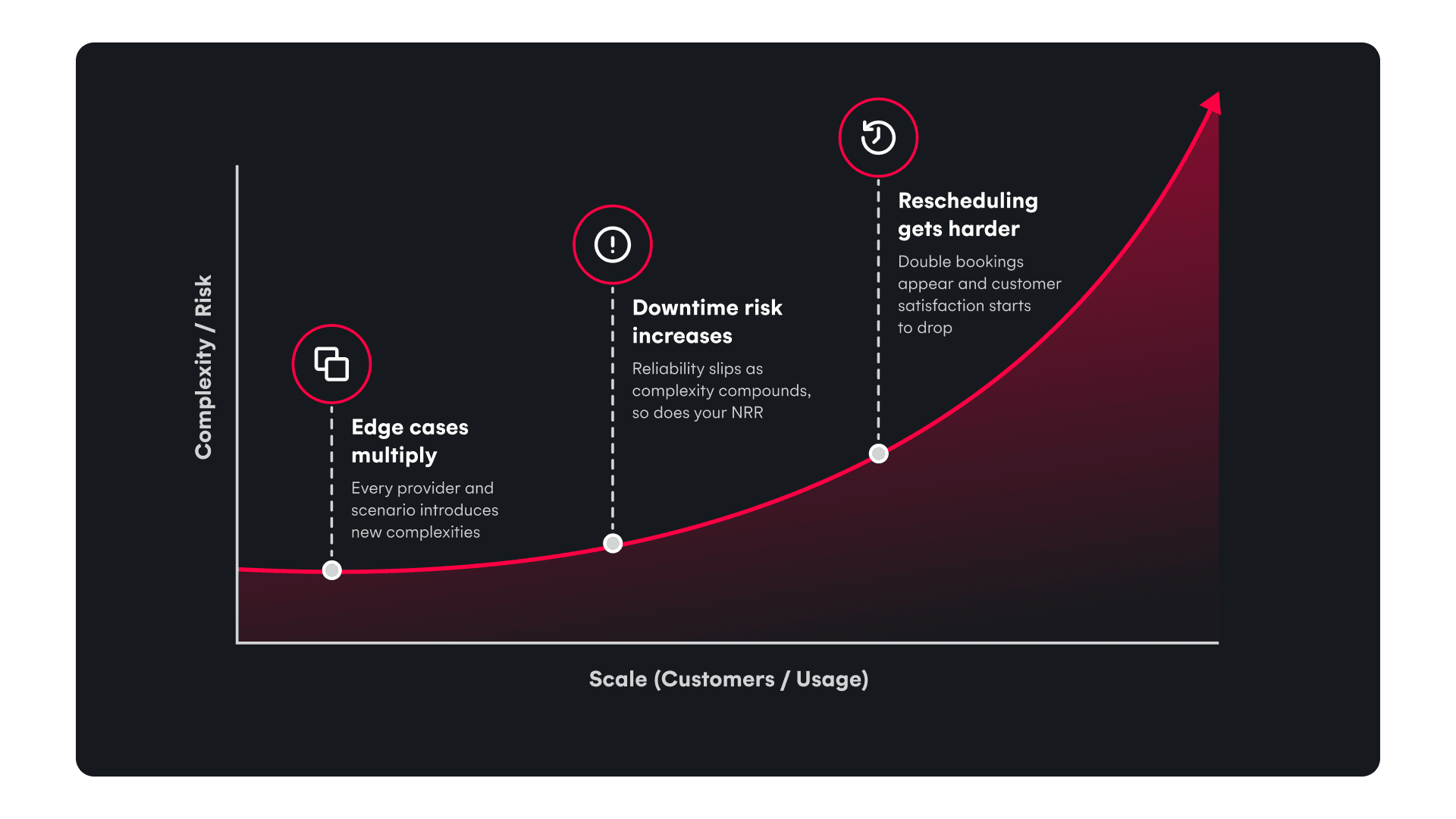
What works for 10s of users breaks at thousands
- Edge cases multiply. Every calendar provider and every scenario adds new complexity.
- Downtime risk increases. Reliability slips as complexity compounds, and net revenue retention slips with it.
- Rescheduling gets harder. Double bookings appear, and customer satisfaction starts to drop.
As the number of users scales, they end up patching poor functionality with manual workarounds. They chase times over email, fix overlapping meetings manually, and have to rebook canceled events. What might have worked for 10s of customers breaks at thousands.
AI agents can't act without context
AI agents need two kinds of context to act for your users: when people are available, and what was said in their meetings. Without that context layer, every autonomous workflow can break.
Our research reveals that 92% of users would consider switching vendors for stronger AI capabilities. While your team is tied up building infrastructure instead of features, your competitors are probably shipping the AI functionality that users are demanding today.
Cronofy provides a single temporal grid for scheduling and meeting capture. Here’s how it compares with building infrastructure in-house:
Building in-house
- Time to launch: 6–9 months
- Ongoing maintenance: 42% of engineering time
- Uptime: you manage it
- Compliance: you manage it
- AI and agent readiness: custom data layer required
- Calendars and conferencing: build each integration separately
Cronofy
- Time to launch: days
- Ongoing maintenance: maintained by Cronofy
- Uptime: 99.99% uptime SLA
- Compliance: ISO 27001 certified, SOC 2 Type 2 attested, GDPR and HIPAA compliant
- AI and agent readiness: MCP Server, the entry point for AI agents, plus meeting conferencing and transcription
- Calendars and conferencing: one API for Google, Microsoft and Apple calendars. Meeting Transcripts covers Zoom, Google Meet and Microsoft Teams


One temporal grid for scheduling and meeting capture
Cronofy is the Temporal Infrastructure connecting agents, systems and teams. Over 100 HR tech products run on it.
One integration covers scheduling, calendars and meeting transcription, on a 99.99% uptime SLA.
