

The challenges of meeting capture
When it comes to meetings, decisions are often undocumented, action items are dropped, and catching up after a missed meeting takes more time and effort than it should. Tools that capture meetings exist, but adopting them can raise issues with privacy, access and where sensitive data might end up.
To gain insights into their meeting preferences and post-meeting admin challenges, we surveyed 31 employees across different departments and seniority levels. The findings reveal that, despite inefficiencies around lost decisions and a lack of follow-up actions, meeting capture inside the systems people already use provides genuine customer retention and revenue opportunities for HR tech products.
Two-thirds of respondents had to ask someone to repeat what was said in a meeting
When meeting conversations happen, decisions are not always retained, or they are lost altogether. The problem is further compounded by slow follow-up actions.
Our survey found that 45% rely on Slack summaries shared by colleagues as their way to catch up after missing a meeting. Slack and Teams messages are short-lived, and sensitive meeting information can’t always be shared on those platforms. Notes get buried quickly, and their quality depends on who wrote them.
The top three reasons for meeting inefficiencies
Our findings reveal that, when it comes to meeting inefficiencies, 52% blame a lack of clear follow-up actions or owners, 26% say key decisions get lost, and 19% point to the lack of a clear agenda.
When a meeting has no clear follow-up actions, lost decisions and an unclear agenda, it risks having no purpose, no suitable outcome, and no real value to the business.

Hours spent in meetings each week, by seniority
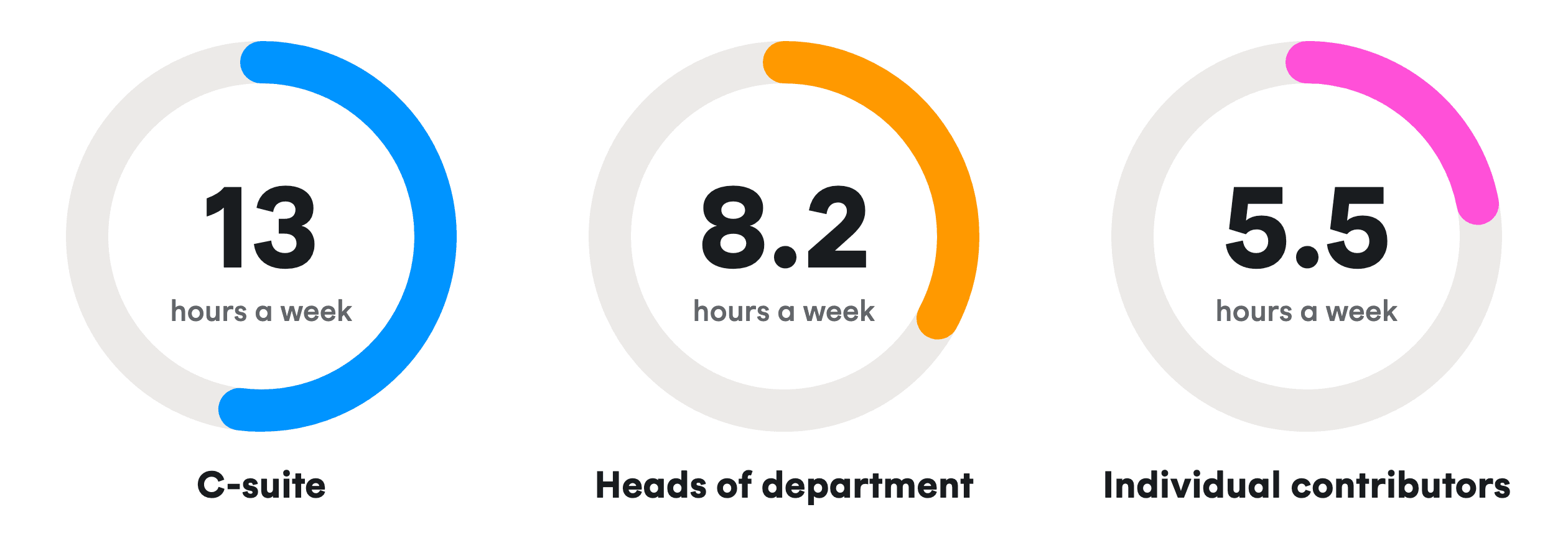
It’s perhaps not surprising that the more senior you are in an organization, the more time you spend in meetings. The chart below reveals that, according to our respondents, the average number of hours spent in meetings each week is: C-suite, 13 hours, heads of department, 8.2 hours, and individual contributors 5.5 hours. That’s an average of 6.4 hours a week.
Time in meetings and then post-meeting admin both rise sharply with senior players, which means they spend less time on arguably the more important work that their roles demand.
52% spend 1–3 hours a week on post-meeting admin
When it comes to post-meeting admin, most individual contributors to the survey cite spending under an hour a week, while heads of department are more likely to spend 1–3 hours or more. Clearly, the more senior employees could benefit most from automating and centralizing meeting transcription.
What would you do with the time you get back?
Reducing post-meeting admin obviously saves time. But what would respondents do with the time saved?
- 73% would work through their tasks faster
- 63% would do more deep work
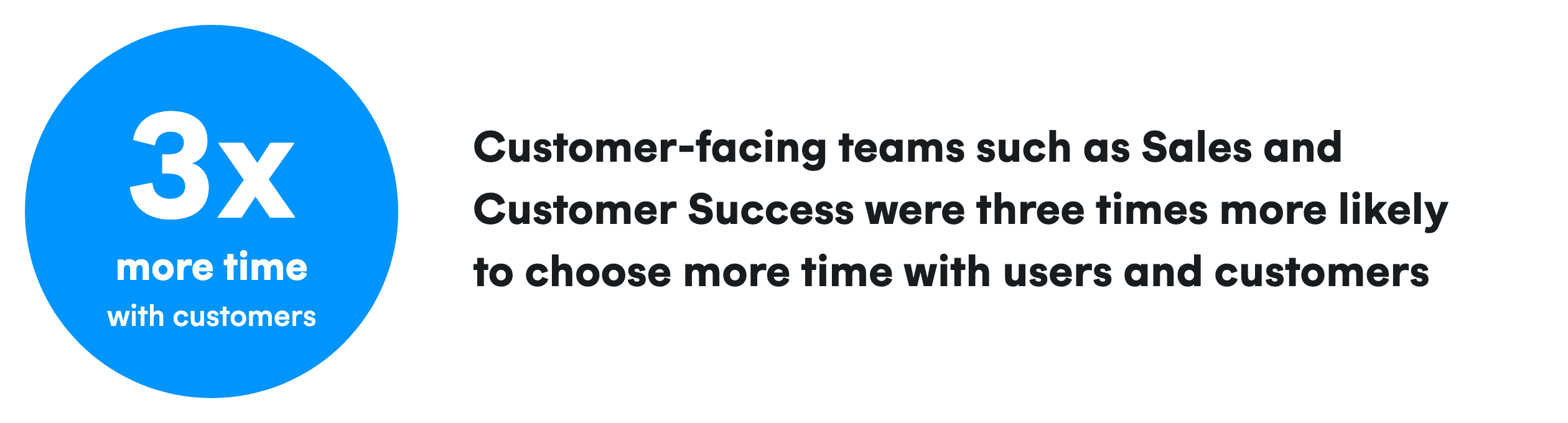
Different departments would use the time saved in different ways. For example, customer-facing teams such as sales and customer success were three times more likely to choose more time with customers. That would have a considerable impact on customer retention and revenues.
They are open to meeting recording, but with control over who accesses it
The employees we surveyed appear to be open to recording and notetaking, especially for external and structured meetings. 80% want automated notetaking for meetings with external parties, such as partner calls, sales calls, vendor meetings and interviews. That’s where the stakes are higher and missed details can be harder to recover. But they want control and the option to opt out.
Engineering teams want more control and transparency over recordings. Only 46% of engineers are comfortable with organization-wide search across recordings, even with opt-out options.

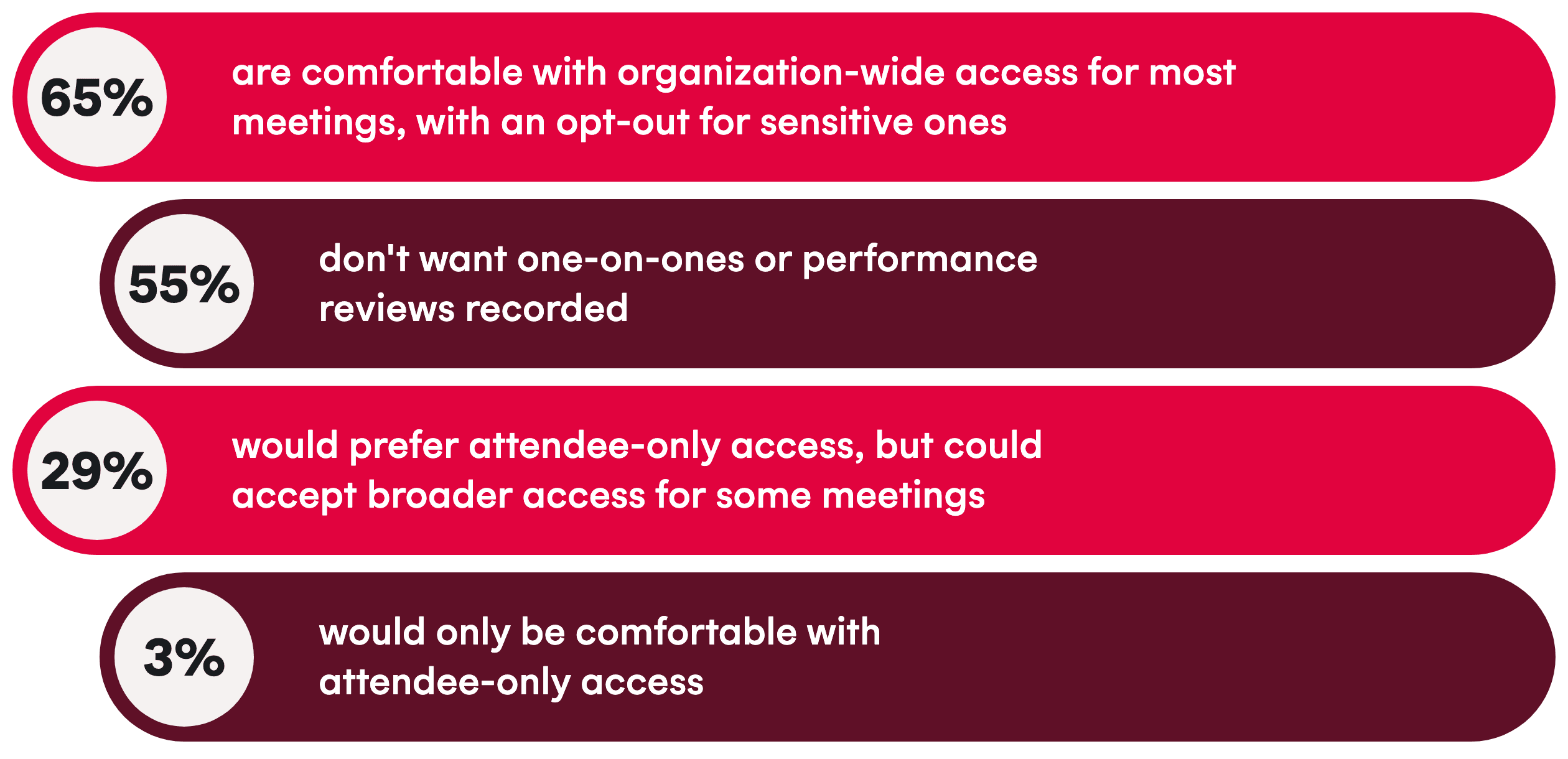
Of our survey respondents, 65% are comfortable with organization-wide access, with an opt-out for sensitive meetings. 55% don’t want one-on-ones or performance reviews recorded. And 29% prefer attendee-only access, but could accept broader access. Only 3% accept attendee-only access only.
Over 60% of enterprises are concerned about sensitive meeting data being processed by third-party AI. That’s what can happen with individual AI notetakers.
Blocking those tools isn’t realistic. In an October 2025 survey of over 2,000 UK employees, Microsoft found that 71% had used unapproved consumer AI tools at work, and 51% do so every week. As the pressure to use AI grows, so will demand for automated notetaking with compliance safeguards built in.
For organizations
When meeting capture is built into the platforms employees already use, the data stays in governed systems. It is processed under one agreement, instead of being spread across unapproved consumer tools.
For SaaS products
Every time users fall back on an individual AI notetaker, they leave the platform where they do their core work. The product loses stickiness and valuable meeting data.
For the platforms that provide capture, native meeting transcription turns a productivity feature into a retention and revenue driver. When interviews, candidate evaluations and sales calls are recorded inside the platform, the platform becomes stickier and much harder to replace.
$17.40
per user, per month, already spent on AI notetakers
The market for AI meeting tools is worth $757.6 million in 2026. Users already pay for this, outside your product. You could be tapping into this revenue stream.
Calculate the potential revenue you could capture
Cronofy is the Temporal Infrastructure connecting agents, systems and teams. Meeting Transcripts runs entirely on Cronofy's own infrastructure. Cronofy is the only sub-processor.
Your users already pay for notetakers outside your product. Estimate how much of that spend you could capture.
