

The conversations your AI never sees
Every hiring platform and HR suite is shipping AI on its record of who was hired, promoted or reviewed. The conversations behind those decisions rarely reach that record. Interviews, screening calls, one-on-ones and reviews are often captured by whatever tool someone happens to have open, or not at all.
That leaves a gap in the hiring and HR record. Closing that gap inside the product is now part of how hiring platforms and HR suites keep customers and win new ones.
Key considerations around interview transcription
- Six decisions shape the value of a transcript: consent, transcript first, the raw transcript, binding capture to the calendar event, data residency and audio retention.
- HR platforms record outcomes. The conversations behind them happen somewhere else, so the AI built on the record works from notes written after the event.
- One in three US workers has had an AI notetaker in a work meeting, so capture is already happening. The question is whether the transcript lands in your own product or in a tool you don't control.
- A raw, timestamped transcript in your product lets your team build evidence-linked scorecards, lifecycle summaries and its own agents.
- When the interview is scheduled through Cronofy, capture is attached to the calendar event, so the transcript stays with the right record through a reschedule.
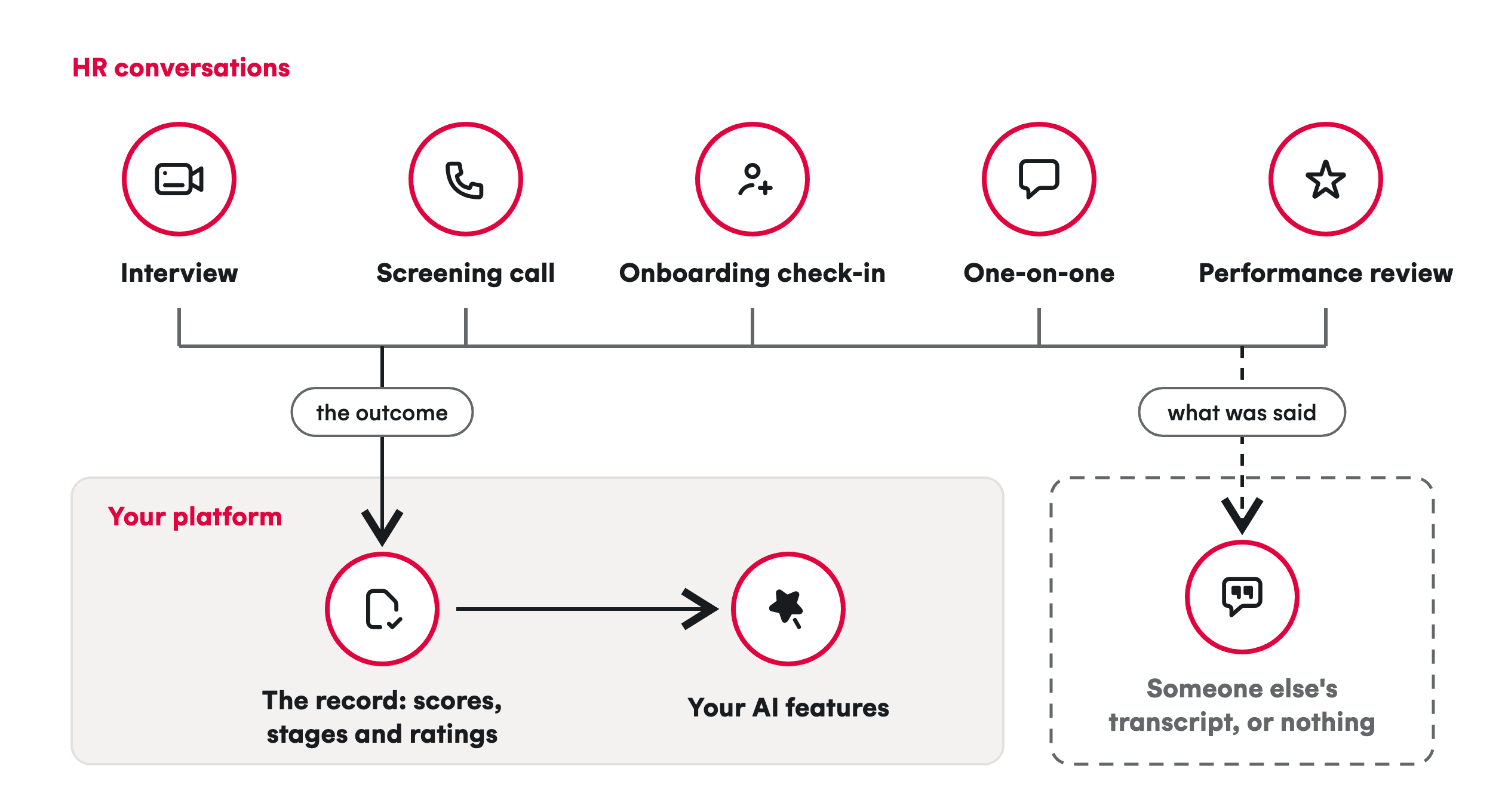
Five conversations, five potential gaps in the record
Five HR conversations shape the decisions your customers make about candidates and employees: interviews, screening calls, onboarding check-ins, one-on-ones and performance reviews.
Your platform stores the outcome of each one, such as a score or a stage change. What was said stays in someone's memory, in a personal notes app, or in a notetaker your platform never hears from. So the most valuable data in the HR workflow often sits in someone else's transcript.
Your AI inherits every gap
Every AI feature on a hiring or HR product roadmap reasons over the record underneath it. Candidate scoring, feedback summaries, skills matching, appraisal summaries and sentiment all depend on what the platform retains. When the conversation is missing, the model works from a three-line note written two hours later.
The customer evaluating your AI is the first to notice. An old decision about notetaking becomes a question about whether your AI can be trusted.
Take a 45-minute panel interview for a senior engineer, with five competencies and feedback written that day. The two scorecards below show what the platform holds from the interviewer's memory alone, and what it holds with the transcript.
Memory, no transcript
- "Strong communicator, 4 out of 5." Written two hours later, from memory.
- Three of five competencies covered. The other two were never noted.
- No evidence to check. The score is taken on trust.
- The AI summary rewrites the notes. It can't add what wasn't captured.
With the transcript
- Every score links to a timestamped passage. The hiring manager reads what the candidate said.
- All five competencies covered. Each is tagged from the conversation.
- One source for the AI and the hiring manager. Both see the same evidence.
- The AI summary draws on the whole conversation. Nothing depends on what was noted.
The interviewer and the candidate are the same in both. The difference is what your platform kept after the interview.
Evidence-linked scorecards already exist. Cronofy customer Pinpoint, a hiring platform, built AI scorecards on Cronofy transcripts. Each scorecard question surfaces the timestamped sections of the interview that relate to it, so interviewers can check the context behind a score.
Interview notetaking is moving from a partner integration to a native feature on hiring and HR product roadmaps. The open question is where the transcript lands: in your product, or in a tool you don't control.
- Capture is already everyday practice. In a July 2026 survey of 500 employed US adults, commissioned by Kolmogorov Law, one in three said an AI notetaker had joined a work meeting. That notetaker arrived with whatever tool someone brought along.
- Buyers expect the AI to use what gets captured. In G2's 2026 Buyer Behavior Report, 72% of 1,038 B2B software decision-makers cited AI as a must-have or a differentiator when selecting software. For a hiring platform or an HR suite, that AI has to reason about interviews, reviews and check-ins.
Cronofy delivers a raw, speaker-attributed transcript with timestamps, plus an optional summary, into your product. Your team owns what gets built on it. Below are nine features, grouped by where they sit in the candidate or employee lifecycle.
Hiring
- Scorecards linked to the exact passage behind each score
- Competency tagging across every interviewer on a panel
- Candidate rediscovery by skill, searched across past interviews
Onboarding and performance
- One-on-one summaries, with commitments tracked from meeting to meeting
- Appraisals grounded in what was said in the review
- Onboarding themes across a cohort of new hires
Your own AI agents
- An AI assistant that answers "what did the panel say about system design?"
- Follow-ups drafted from what was agreed
- Alerts when a required interview question was missed
Whether you build or buy, six decisions shape the value of the transcript. They matter to your AI, to your customers' security reviewers and to the people being interviewed.
- Consent. Ask for consent when the interview is booked, repeat it in the invite, and let any participant remove the notetaker. Your product owns this flow. Cronofy lets you set the notetaker's name and avatar, so it can join under your product's name.
- Transcript first, video optional. Candidates resist being recorded on video, and so do some recruiters. Lead with the transcript and summary, and make video optional in your product. With Cronofy, your product chooses what it downloads, so it can take the transcript and summary without the video file.
- The raw transcript. A summary is an interpretation. Feed the raw, timestamped, speaker-attributed text to your own models, and the intelligence layer stays yours. Check that a vendor hands over the raw text as well as the summary.
- Bound to the calendar event. Interviews can move. When the interview is scheduled through Cronofy, the notetaker is attached to the calendar event, and a reschedule keeps the transcript linked to the right session and the right record.
- Data residency. HR data comes with residency questions. Recording, transcription and storage happen in the data center you select: the UK, US, Canada, Germany, Australia or Singapore. The optional summary is generated by a large language model that may run in another region within the US, EU or Australian geography. The Canada data center uses the US geography, and Singapore uses the Australian one.
- Short audio retention. Audio holds a person's voice, and the transcript already holds what they said. Keep the transcript and delete the audio within days. At Cronofy customer Pinpoint, audio stays on Cronofy's infrastructure for seven days, for debugging only, and is then removed.
Both routes end with the transcript in your product. They differ in who owns the integrations behind it.
Build it yourself
- Conferencing platforms. Zoom, Google Meet and Microsoft Teams, each integrated and maintained by you
- Transcript delivery. Your own pipeline and transcription vendor contracts
- Data processing. Third-party sub-processors to disclose in every security review
- Data residency. Depends on each vendor you choose
- Rescheduled interviews. Recordings re-linked to the right record by hand
- Time to ship. Months of build, then ongoing maintenance
Build on Cronofy
- Conferencing platforms. One API across Zoom, Google Meet and Microsoft Teams, maintained by Cronofy
- Transcript delivery. Speaker-attributed text with timestamps, plus an optional summary, in 30+ languages
- Data processing. It runs entirely on Cronofy's own infrastructure. Cronofy is the only sub-processor.
- Data residency. Six data centers. Recording, transcription and storage stay in the one you select
- Rescheduled interviews. Capture bound to the calendar event when the interview is scheduled through Cronofy
- Time to ship. About four weeks at Pinpoint, UI included


Can we take the transcript without the video?
Yes. Your product chooses what it downloads from Cronofy, so it can take the transcript and summary and leave the video recording behind.
Do we get the raw transcript, or only a summary?
You get the raw transcript, attributed to each speaker and timestamped, plus an optional summary.
Which conferencing platforms does Meeting Transcripts cover?
Zoom, Google Meet and Microsoft Teams, through one API.
Where is interview data stored?
Recording, transcription and storage happen in the data center you select: the UK, US, Canada, Germany, Australia or Singapore. The optional summary is generated by a large language model that may run in another region within the US, EU or Australian geography. The Canada data center uses the US geography, and Singapore uses the Australian one.
What happens when an interview is rescheduled?
When an interview is scheduled through Cronofy, the notetaker is attached to the calendar event and stays with the right session through the reschedule.
How long does it take to ship?
Pinpoint took about four weeks to bring AI notetaking live, including its own UI work.
What are the benefits of interview transcription for HR teams?
Interview transcription enables organizations to manage candidates and employee processes more efficiently. It ensures important conversations are accurately documented, easily accessible, and available to support crucial HR decisions.
Filling the gap in your AI roadmap
Cronofy is the Temporal Infrastructure connecting agents, systems and teams. Meeting Transcripts, part of Cronofy's meeting conferencing and transcription capabilities, records, transcribes and summarizes interviews, one-on-ones and reviews across Zoom, Google Meet and Microsoft Teams, and delivers the raw transcript into your product. Schedule the interview through Cronofy and capture is bound to the calendar event, on Cronofy's own infrastructure, in the data center you select.
